
Category

Neurosurgery

Cross Post: An Endovascular Approach for Idiopathic Intracranial Hypertension: Assessing Morphometric Candidacy After Venous Sinus Stenting.

By Access to Care, CNS Spotlight, Cross Post, Drugs and Devices, Medical Research, NeurosurgeryNo Comments

From time to time on the Neurosurgery Blog, you will see us cross-posting or linking to items from other places when we believe they hit the mark on an issue. We wanted to bring attention to a recent publication in Neurosurgery, an official journal of the Congress of Neurological Surgeons, which provides multimedia, prompt publication of scientific articles on clinical or experimental surgery topics important for the brain, spine, and peripheral nerves, reviews, and other information of interest to readers across the world. The article, “An Endovascular Approach for Idiopathic Intracranial Hypertension: Assessing Morphometric Candidacy After Venous Sinus Stenting” is published as part of Neurosurgery’s High-Impact Manuscript Service (HIMS).

Idiopathic intracranial hypertension (IIH) is characterized by elevated intracranial pressure in the absence of a mass lesion or obstructive hydrocephalus. It predominantly affects women of childbearing age and typically presents with headache, pulsatile tinnitus, and, in severe cases, visual morbidity from papilledema. When medical therapy and weight loss fail, conventional cerebrospinal fluid (CSF) diversion remains imperfect: ventriculoperitoneal and lumboperitoneal shunts carry nontrivial complication and revision rates. Endovascular venous sinus stenting offers a less invasive option for selected patients with venous outflow obstruction, although it generally requires antiplatelet therapy and can be limited by symptom recurrence.

The CereVasc eShunt® Implant is an investigational endovascular CSF shunt designed to address some of these constraints by replicating the function of arachnoid granulations. Delivered via a venous approach through the groin, it accesses the cerebellopontine angle cistern from the inferior petrosal sinus. It drains CSF across the dura into the jugular venous system without a cranial burr hole, invasive catheters, or peritoneal tubing. Early experience in normal pressure hydrocephalus has been encouraging; although whether IIH anatomy can routinely permit analogous deployment has been less clear.

In a morphometric study published in Neurosurgery, investigators at Tufts Medical Center evaluated IPS and cerebellopontine angle cistern dimensions in 84 adults with IIH against device- and trial-informed eligibility thresholds. Under stringent, moderate, and permissive cistern depth criteria, eShunt deployment was anatomically feasible in 43%, 69%, and 82% of patients, respectively. The authors conclude that a substantial fraction of adult IIH patients meet morphometric criteria for deployment based on cistern and IPS anatomy alone, and they position endovascular CSF shunting as a potential complement—or alternative—to traditional CSF diversion and venous sinus stenting.

The eShunt® Implant System remains investigational. The anatomic feasibility data in this study does not establish clinical efficacy in IIH, but instead supports further exploratory clinical study in carefully selected patients.

To read the full Neurosurgery article, click here.
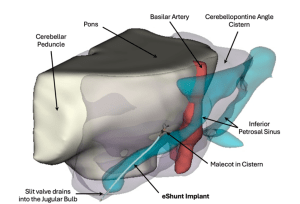
 

Figure 1A. Three-dimensional rendering of the CereVasc eShunt Implant in the inferior petrosal sinus, with surrounding structures at the cerebellopontine angle cistern. Reproduced from Vajipayajula DN, Yu A, Koo AB, et al. An Endovascular Approach for Idiopathic Intracranial Hypertension: Assessing Morphometric Candidacy After Venous Sinus Stenting. Neurosurgery. 2026. DOI: 10.1227/neu.0000000000004154. © Congress of Neurological Surgeons 2026. All rights reserved.


Washington Committee: 50 Years of Advocacy and Impact

By AANS Spotlight, CNS Spotlight, NeurosurgeryNo Comments

Fifty years ago, the American Association of Neurological Surgeons (AANS) and Congress of Neurological Surgeons (CNS) recognized the growing impact of federal policy on medicine and took bold action: they established the AANS/CNS Washington Committee for Neurological Surgery. This formal presence in the nation’s capital has since served as the unified voice of neurosurgery in Congress and within federal agencies.

“Throughout its history, the Washington Committee has been critical to CNS’ mission of enhancing health and improving lives. We are grateful to our Washington Committee representatives for their tireless efforts to ensure healthcare policies are patient-centered and address the needs of both patients and neurosurgeons,” states Regina Shupak, CNS CEO. Since its inception in 1975, the Washington Committee has worked to advance neurosurgery, influence policy decisions, and advocate for patient access to high-quality neurosurgical care.

Over the decades, the Washington Committee broadened its focus to address the full range of federal policies impacting neurosurgical practice and patient care — from reimbursement and medical liability reform to quality reporting, research funding, and access to innovative technologies. This strategic expansion has ensured that neurosurgery remains at the table and it has also achieved meaningful policy victories.

To keep pace with a rapidly evolving policy landscape, the Washington Committee expanded its structure, establishing subcommittees led by neurosurgeon volunteers that focus on key areas such as coding and reimbursement, clinical guidelines, medical device regulation, public communications, and quality improvement. It also includes delegates to the American Medical Association to maintain influence in organized medicine. Supporting this work has grown from a single staff member to a team of five, complemented by experienced consultants and targeted coalitions that the Committee has established and supports to advance key advocacy priorities.

“The Washington Committee has been at the forefront of major health care policy issues for 50 years, successfully advocating for fair reimbursement, reducing regulatory burdens, and securing funding for critical neurosurgical research and training. Through its steadfast dedication and strategic advocacy, the AANS and the CNS have preserved access to life-saving neurosurgical care for patients while ensuring neurosurgeons can continue to innovate and lead in an evolving health care landscape,” states Katie O. Orrico, JD, AANS CEO.

“The Washington Committee’s accomplishments over the past five decades highlight the incredible dedication of our neurosurgeons — both in the operating room and in the halls of Congress — and it has been an honor to play a small role in helping advance sound health policy. As we look to the next 50 years, the work of the Washington Committee is more critical than ever to help neurosurgery navigate complex policy challenges and drive meaningful legislative and regulatory change to preserve the specialty for generations of neurosurgeons and patients to come,” Ms. Orrico added.

The Washington Committee remains committed to advancing policies that support neurosurgical excellence, scientific innovation, and equitable patient access. Its legacy of impact reflects the strength of neurosurgery’s collective voice — and its future depends on continued engagement from the neurosurgical community.

Editor’s Note: This article originally appeared in the Spring 2025 CNS Congress Quarterly. We hope you will share what you learn from our posts. We invite you to join the conversation on X by following @Neurosurgery, @AANSNeuro, and @CNS_Update.

Overview of the Open Payment Database: What do I need to know?

By NeurosurgeryNo Comments

The intertwining relationship between industry and medicine has been evident and ever-so apparent in recent decades. While these relationships are vital for innovation, concerns of potential conflict of interest (COI) have called into question the objectivity of scientific research and patient care. To help alleviate these concerns, the Centers for Medicare & Medicaid Services (CMS) opted to increase the transparency of physician-industry interactions. Read More